Next, Descartes argues that there must be at least as much reality in a cause as in the effect of that cause. The effect gets its’ reality from the cause, and for the cause to give reality to the effect must first possess it. Therefore, something cannot come from nothing, and, further, what is more perfect; contains more reality, cannot arise from what is less perfect. This is not only true for formal reality, but also for ideas where one is considering objective reality. For example, a stone can only come into existence by something that contains, either formally or eminently, everything to be found in the stone.
Finally, since Descartes exists and is imperfect, has ideas, and knows of the attributes that define a perfect being, and no effect can have more reality than its’ cause, then a more perfect being must exist. A being that possesses all the attributes Descartes describes because a finite being cannot have an idea of infinity without their being something infinite, or an ignorant being who doubts and is imperfect having an idea of something omniscience and perfect, or a not all-powerful being having an idea of omnipotence without there being something that is all-powerful. And since Descartes has proven to have not created himself, which exists, because he would have given himself all the attributes previously mentioned and he does not contain all these attributes at the time of writing his Meditations, he must have been created by a more perfect being. He could have been created by a number of beings less perfect than perfection, but they must have been created by something more perfect, until the ultimate cause is reached, which is God. Descartes also argues that it cannot be supposed that several partial causes contributed to his creation because the inseparability of God is one of the most important attributes of His perfection. For no cause could have made him understand the interconnection of the perfections without making him recognize what they were.
To me, Descartes succeeds in his proof for the existence of something that possess the attributes that he suggests define a perfect being. And this thing is benevolent, inseparable, and contains all the attributes of a human, but not limited to. I believe this proof can be used to define the universe itself, and not a sentient being that exists separately from it. All of these attributes can define the universe that we exist within. It is the all-powerful, all-knowing, creator, and possess all the modes which make up thinking, but this may not be its’ essence, just a function. I do not think Descartes proves there is a God who has a plan and is concerned with the emotions of humans. I think benevolence exists within the universe, but the universe itself is indifferent to the pain of humans. I do not believe the universe can be a deceiver because it is the creator and for it to deceive it would have to create a being that is capable of being deceived and this would be a being that if deceived it would still be following the function given to it by its’ creator, and if the universe could will pain upon a human through deception, the human would understand it is the will of the infinite universe and would accept it as true until the universe changed again. Finally, I think Descartes makes a great argument for existence, but the ultimate decision of the existence of God as anyone knows Him is left to faith.
Tuesday, May 6, 2008

Descarters proof for the existence of God part I
Descartes makes a few arguments for the existence of God. His most famous, which can be found in the Third Meditation, can ultimately be summed up in five steps. First, Descartes proves that he exists. He attempts to withdraw all his senses and regard all thoughts as false and worthless. He discovers that he is a thinking thing; a thing that doubts. Even though the objects of his sensory experience may have no existence, the modes of thinking still exist; therefore he exists. And from this process of doubting Descartes argues that he is imperfect, because a perfect being has all knowledge and cannot doubt.
Second, Descartes discovers that all ideas are either innate or adventitious. The innate ideas could not have been put there by himself, because if he could put innate ideas into himself then he could just as easily put other ideas into himself also which he proves that he did not because he doubts. So, the innate ideas must be put into his mind by a greater being. The adventitious ideas are external to him, and since he cannot create ideas from nothing, there must be some objective reality to these ideas. Even though some of these ideas seem absurd and completely without truth, they still are made up of an external reality. Like, the image of a mermaid, which is not known to exist, comes from the image of a woman and a fish. Therefore, something exists externally from him, and his thoughts are dependent on these objects being real.
Third, Descartes describes what he believes to be the attributes of God. He has ideas of eternity, infinity, omniscience, omnipotence, and creation; the defining attributes of God. And since all fraud and deception depend on there being a defect, God cannot be a deceiver because he is perfect by definition. Also, after Descartes’ proof for the existence of God, he says since he was created by God then he is somehow created in His image or likeness, and since he is a thinking thing, so, too, God must be a thinking thing.
Second, Descartes discovers that all ideas are either innate or adventitious. The innate ideas could not have been put there by himself, because if he could put innate ideas into himself then he could just as easily put other ideas into himself also which he proves that he did not because he doubts. So, the innate ideas must be put into his mind by a greater being. The adventitious ideas are external to him, and since he cannot create ideas from nothing, there must be some objective reality to these ideas. Even though some of these ideas seem absurd and completely without truth, they still are made up of an external reality. Like, the image of a mermaid, which is not known to exist, comes from the image of a woman and a fish. Therefore, something exists externally from him, and his thoughts are dependent on these objects being real.
Third, Descartes describes what he believes to be the attributes of God. He has ideas of eternity, infinity, omniscience, omnipotence, and creation; the defining attributes of God. And since all fraud and deception depend on there being a defect, God cannot be a deceiver because he is perfect by definition. Also, after Descartes’ proof for the existence of God, he says since he was created by God then he is somehow created in His image or likeness, and since he is a thinking thing, so, too, God must be a thinking thing.
Monday, April 28, 2008
So How is Metaphysics Possible?
For Kant, the metaphysics of previous generations is worthless nonsense. But it is at the end of his Treatise that Kant answers the question that he started his book with. His answer is: "critique." Reason can't teach us regarding what lies beyond its grasp but it can help us categorize and classify the different concepts of our faculties of sensibility, understanding, and reason. Instead of looking outward, we should look inward.
For Kant, science is a body of synthetic a priori knowledge. Reason has not power to gain a priori knowledge of things that are outside our experience.ut
For Kant, all the metaphysics that has been conducted up till now has been completely useless.
For Kant, science is a body of synthetic a priori knowledge. Reason has not power to gain a priori knowledge of things that are outside our experience.ut
For Kant, all the metaphysics that has been conducted up till now has been completely useless.
But even then he says that we are drawn to metaphysics and that we can't leave it alone. He envisions that the previously dogmatic metaphysics should begin to advance the critical philosophy that he envisions with great vigor.
He also challenges anyone who disagrees with his dismissal of all dogmatic metaphysics and he asks them to give one example of metaphysical synthetic a priori judgment that can and has been proven with certainty. It is impossible for this type of judgment to be based on conjecture, because something that is categorized as an "a priori truths" is itself necessary, and thus can't be based on common sense, since we derive our common sense from experience. Common sense can't advance metaphysics as a science.
He also challenges anyone who disagrees with his dismissal of all dogmatic metaphysics and he asks them to give one example of metaphysical synthetic a priori judgment that can and has been proven with certainty. It is impossible for this type of judgment to be based on conjecture, because something that is categorized as an "a priori truths" is itself necessary, and thus can't be based on common sense, since we derive our common sense from experience. Common sense can't advance metaphysics as a science.
Various Ideas of Reason and how they Mislead the Understanding
In the last part of his book, Kant talks about how the numerous ideas of reason and how the mislead the understanding into posing insoluble metaphysical questions. Kant, like Hume, draws a distinction between metaphysics from mathematics and science. But instead, he says that the former has bounds while the later two don't have any bounds, but instead have two limits. Math an Science are complete and they are limited only in that their scope is not absolutely general. Math can't answer metaphysical questions & science can't give us insight to into things in themselves. But morality and mathematics aren't needed in mathematical explanations and the nature of things in themselves does not affect the advancement of science.
Metaphysics according to Kant is bounded. Why? Because reason poses questions for itself that it cannot answer. However, in these questionings, our reason bumps against boundaries that it can't got past. This includes the fact that we can't gain definite knowledge outside our experience. But this is useful to us. Although we can't go beyond them, we can infer that there exists something beyond them. We can also infer the connection that they must have with the world that we do perceive.
For Kant, we can't prove anything about the existence of God or His nature.
Metaphysics according to Kant is bounded. Why? Because reason poses questions for itself that it cannot answer. However, in these questionings, our reason bumps against boundaries that it can't got past. This includes the fact that we can't gain definite knowledge outside our experience. But this is useful to us. Although we can't go beyond them, we can infer that there exists something beyond them. We can also infer the connection that they must have with the world that we do perceive.
For Kant, we can't prove anything about the existence of God or His nature.
On Causal Connections
Humean skepticism comes about when Hume asks how we perceive causal connections between events. Hume declares that we can't discover the concept of causal connection by reason alone. The conclusion that he comes to is that we have no rationally justified knowledge of cause and effect. Our causes are justified by the habit of seeing certain events result from previous events. With regards to this, Kant agrees that we can't discover the concept by means of reason. But, unlike Hume, he does not conclude that this concept is just a result of habit or custom. He suggests that causation is a priori concept of understanding applied to appearances. We can't know anything about things in themselves. Cause and effect is not to be found in these appearances. It is a part of the form given by understanding. Causation is a type of experience that makes it intelligible to us. Hume questions us as to how we can derive pure concepts from experience and responds to his own inquiry that we can't. Kant agrees with this. Wen cant derive pure concepts from experience, but instead we derive experience from these pure concepts.
On the Possibility of Science
Another question that Kant asks is "how is pure natural science possible?" To this Kant says that when we talk about nature we are talking about objects of experience as they appear to us.
These experiences should be in line with universal and necessary laws . According to him, we do study the natural sciences and utilize universal and necessary laws. Thus there is some pattern of regularity in our experiences, but the question is how can this be?
For Kant, there is a difference between judgments of perception and judgments of experience. The former bring together many empirical intuitions and are only subjectively valid. The later apply concepts of understanding to judgments of perception, changing them into objective, universally valid laws. The difference between these two forms of judgments is that the former deal only with what we sense, while the latter deal with what we infer from our perceptions. Judgments of perceptions are not disputable because they are completely subjective. You can't tell me that the sky doesn't appear blue, red, white, or hot pink to me. Judgments of experience can be disputed because they are objective. Although you couldn't tell me what color the sky looks like to me, you can tell me what color it really is.
These experiences should be in line with universal and necessary laws . According to him, we do study the natural sciences and utilize universal and necessary laws. Thus there is some pattern of regularity in our experiences, but the question is how can this be?
For Kant, there is a difference between judgments of perception and judgments of experience. The former bring together many empirical intuitions and are only subjectively valid. The later apply concepts of understanding to judgments of perception, changing them into objective, universally valid laws. The difference between these two forms of judgments is that the former deal only with what we sense, while the latter deal with what we infer from our perceptions. Judgments of perceptions are not disputable because they are completely subjective. You can't tell me that the sky doesn't appear blue, red, white, or hot pink to me. Judgments of experience can be disputed because they are objective. Although you couldn't tell me what color the sky looks like to me, you can tell me what color it really is.
Is Mathematics Possible
The first question for Kant is "how is pure mathematics possible?" If math is based on synthetic a priori cognitions, we should, in theory, be able to draw connections between different concepts by pure intuition. Intuition would connect two things that are connected in synthetic judgments. There are two different types of intuitions for Kant, namely, empirical intuitions and pure intuitions. The first are what we normally call perception. Since math basically consists of the former, meaning synthetic, a priori judgments, there should be a form of pure intuition that is innate in us and allows us to connect different concepts without any reference to the experience of our senses. The reply that Kant gives is that space and time are not things in themselves, but they are the form and sensibility. These are innate intuitions that shape how we perceive the world. Thus, before any concept the things we experience as a result of our senses, we would still have some concept of space and time. Space and time are not things in and of themselves, rather they are empty forms that determine how things appear to us. This is true for all the objects that we perceive within space and time. They do not exist alone, but the objects that we perceive are appearances of things.
Kant was lead, as a result, to three final remarks:
1. That we can have a priori certainty of geometry only because we have pure intuition of space. This certainty is due to the fact that we are only examining our own mental framework, and not things as they are in the world.
2. The says that he is not engaged in idealism. According to the view of idealists there are no real objects in the world. The only things that really exist are minds. Though he believes that we can not perceive things them self, Kant does not deny the existence of the object or any other reality in the world besides minds.
3. Appearance can be deceptive. We can misinterpret what we see and be deceived by such. If space and time exist as realities, then they can be misinterpreted by us, but since they are not realities, but just appearances, they are a priori certain.
Kant was lead, as a result, to three final remarks:
1. That we can have a priori certainty of geometry only because we have pure intuition of space. This certainty is due to the fact that we are only examining our own mental framework, and not things as they are in the world.
2. The says that he is not engaged in idealism. According to the view of idealists there are no real objects in the world. The only things that really exist are minds. Though he believes that we can not perceive things them self, Kant does not deny the existence of the object or any other reality in the world besides minds.
3. Appearance can be deceptive. We can misinterpret what we see and be deceived by such. If space and time exist as realities, then they can be misinterpreted by us, but since they are not realities, but just appearances, they are a priori certain.
Sunday, April 27, 2008
The Main Question
 The Prolegomena to Any Future Metaphysics begins almost right away with the main reason as to why the book was writtein in the first place. This question is regarding whether or not any metaphysics is possible. If such a subject were a science, then why does it not advance like all other sciences? If it is not a science, what are the grounds on which its claims to truth rest? At that specific time there was no standard for agreement on metaphysical inquiries.
The very fact that this question can be postulated itself implies that the validity of metaphysics is doubtable. Some people, who according to Kant, give claims that they have studied the subject might say that it is real, but according to Kant, metaphysics needs a sturdier foundation that it has.
It is interesting to note that the very author/philosopher that led Kant to such conclusions was David Hume, who according to Kant, "threw no light on this species of knowledge, but he certainly struck a spark from which light might have been obtained, had it caught some inflammable substance and had its smoldering fire been carefully nursed and developed," ( Source http://www.mnstate.edu/gracyk/courses/phil%20306/kant_materials/prolegomena2.htm).
Hume concluded that if our knowledge of causes and their effects is not based on reason but rather on custom, all the metaphysical theories that attempt to explian how our reason leads us to such knowledge are worthless. Kant found that all metaphysics is based on a priori reasoning and is thus open to Humean attack. He shows how connections can be drawn a priori and how metaphysics is possible in The Critique of Pure Reason, of which the Prolegomena is a short summary.
HUME AND DIFFERENT TYPES OF SKEPTICISM
Hume has made a distinction between two different types of skepticism, each of which has an extreme from and a moderate form. The extreme forms of skepticism are defined with the universal doubt of Descartes. No claim is acceptable to this form of skeptic unless it is deduced from some first principle. For Hume, however, there is no such first principle that is self-evident enough to be beyond doubt. Secondly, even if there were such a principle, we would not be able to advance beyond it. Although it must be admitted that this extreme form is not workable, Hume does commend this type of skepticism in a more moderate form.
Hume's skepticism has been a kind of consequent skepticism which questions our habitual conclusions and judgments by calling into doubt the grounds based on which they are secured. Hume considers the testimony of the senses, which suggest the existence of a world external to us and a world that is independent of our senses. We are led by instinct to suppose that these senses report an accurate replica of the world around us. But to Hume, our belief in an external world is not rationally justified. Part of the reason for this is that our perceptions are changing as we move in the world. Still yet another justification Hume uses for his belief is that there are cases of madness or dreams where or senses deceive us. This form of skepticism can lead to complete inaction. IF WE DOUBT OUR SENSES, WE CAN NOT UNDERSTAND MATTER. This type of skepticism also leads to doubting causal reasoning.
Hume's skepticism has been a kind of consequent skepticism which questions our habitual conclusions and judgments by calling into doubt the grounds based on which they are secured. Hume considers the testimony of the senses, which suggest the existence of a world external to us and a world that is independent of our senses. We are led by instinct to suppose that these senses report an accurate replica of the world around us. But to Hume, our belief in an external world is not rationally justified. Part of the reason for this is that our perceptions are changing as we move in the world. Still yet another justification Hume uses for his belief is that there are cases of madness or dreams where or senses deceive us. This form of skepticism can lead to complete inaction. IF WE DOUBT OUR SENSES, WE CAN NOT UNDERSTAND MATTER. This type of skepticism also leads to doubting causal reasoning.
Regarding Miracles
David Hume and Miracles

 " A miracle is a violation of the laws of nature; and as a firm and unalterable experience has established these laws, the proof against a miracle, from the very nature of the fact, is as entire as any argument from experience can possibly be imagined...Nothing is esteemed a miracle, if it ever happen in the common course of nature." (Source: http://www.fordham.edu/halsall/mod/hume-miracles.html)
I personally believe that such definition of a miracle is not proper, but that it does not negate the existence of miracles. First of all, let us explain what a natural law is, for me, an occuracne that occurs in the natural world and is the basis of the formation of laws of nature. Human beings try to analyze nature and understand the laws of nature, but that does not mean that such an analysis will completely understand all the laws of nature. Meaning that we can not necessarily comprehend all the laws of nature. If we can not comprehend the laws of nature, then we cannot say that a miracle can not exist, because a miracle, that is an instance in which the laws of nature are upheld for some time. Since the word miracle contains the words natural laws within it, we can not understand what it means for a miracle to occur.
Furthermore, I disagree with the whole definition of word miracle that Hume has used. Why? Given that we can not understand all the natural laws as I just mentioned, can a miracle not just be an extension of the principles of nature that we do not yet understand?

 " A miracle is a violation of the laws of nature; and as a firm and unalterable experience has established these laws, the proof against a miracle, from the very nature of the fact, is as entire as any argument from experience can possibly be imagined...Nothing is esteemed a miracle, if it ever happen in the common course of nature." (Source: http://www.fordham.edu/halsall/mod/hume-miracles.html)
I personally believe that such definition of a miracle is not proper, but that it does not negate the existence of miracles. First of all, let us explain what a natural law is, for me, an occuracne that occurs in the natural world and is the basis of the formation of laws of nature. Human beings try to analyze nature and understand the laws of nature, but that does not mean that such an analysis will completely understand all the laws of nature. Meaning that we can not necessarily comprehend all the laws of nature. If we can not comprehend the laws of nature, then we cannot say that a miracle can not exist, because a miracle, that is an instance in which the laws of nature are upheld for some time. Since the word miracle contains the words natural laws within it, we can not understand what it means for a miracle to occur.
Furthermore, I disagree with the whole definition of word miracle that Hume has used. Why? Given that we can not understand all the natural laws as I just mentioned, can a miracle not just be an extension of the principles of nature that we do not yet understand?
Locke and Moral Reasoning
One of the ideas that Locke becomes known for as a result of his belief that there is no such thing as innate human knowledge is the belief that human morals are not innate. The example that he draws on is that there is a disavowal of morality in some cultures. The only thing that is universal in human beings according to Locke is the desire to achieve happiness and to avoid misery. The idea that patterns of human conduct are found to be widespread and have some form of conformity with morality is only in virtue of a providential association of rectitude with some more short-sighted understanding of personal and public welfare. Besides all this, he still did not believe that there is anything about human morality that is universally acknowledged by all.
Besides all this, it is preposterous to claim that Locke was a moral relativist. Our current moral discourse is subject to the kind of perfect precision that should yield some possibility of demonstrable truth. Thus, moral truths are definable, because each of them signifies a mixed mode whose determinate content is made secure by its being created in the mind. Locke upheld the belief that careful attention to the complex ideas involved would result in some form of demonstrable form of human knowledge.
Besides all this, it is preposterous to claim that Locke was a moral relativist. Our current moral discourse is subject to the kind of perfect precision that should yield some possibility of demonstrable truth. Thus, moral truths are definable, because each of them signifies a mixed mode whose determinate content is made secure by its being created in the mind. Locke upheld the belief that careful attention to the complex ideas involved would result in some form of demonstrable form of human knowledge.
That Knowledge is not Innate
One of the ideas that Locke denies is the belief that knowledge is innate. The innatist declare that universal consent of a particular piece of information implies that they have an innate origin. To this, Locke responds that:
1. The denial of the supposed fact of universal consent
2. That if there were any genuine instances of universal consent, they would be better explained by universal possession of intellectual faculty or by being acquired through some universal experience, not innate knowledge.
If the innatist are true in their statement, then one could say that if logic, for example, were known to be innate, then children and those that are mentally challenged, both examples used by Locke, would be the ones that are best versed in logical principles. Yet is that true? The innatist response to this would be that the coming forth of innate knowledge is delayed until the person is able to employ the faculty of reasoning. Yet one can ask as to why this would be the case? If reason itself is needed to discover these principles, then the argument of the innatist is self-defeating, that that which is not known must be employed to make itself apparent. Locke uses the argument that reason and logic are coincidental features of human development.
Locke on Language

The importance of language for Locke is so significant that he has dedicated a whole part of his book on its nature, use and importance. According to him, language is the basic instrument of all human social interactions. For the employment of language, we have the first the physical organs, like the tongue and the mouth, that help us articulate a variety of sounds. We also have the ability of using these sounds that are produced by the respective organs to as sings of internal conception through which we communicate all our thoughts. Finally, we also employ words as general terms that can be applied to many particular things. Language is designed to serve all the practical needs of human life.
The problem that comes up after this discussion is how do we achieve our communicative goals. Locke suggests that all our words are representations of ideas. Locke also said that the absence of any universal language reveals that the connection between the word and the idea that it represents is not natural but rather conventional.
There is yet another problem here, and that is that since ideas differ from person to person and the association of words to ideas is purely voluntary, it follows from all this that the proper representation of a particular word depends on the particular idea in the mind of the speaker to which the hearer has no access.
Locke's Modes
Although Locke did believe that some simple ideas occur together naturally in our experiences, he also believed that most of the complex ideas that we possess are the result of the application of the higher powers of the brain. Complex ideas are just a combination of numerous simple ideas that result in the creation of a new whole. Repeated using of these powers creates the whole variety of ideas that humans beings can have.
Locke believes that complex ideas can be categorized into three:1. Modes
2. Substances
3. Relations
Of the three different types of ideas just mentioned, I will now just only talk about the first.
Modes
One simple mode is a complex idea whose components are parts, variations, and or combinations of one simple idea.
Mixed modes are complex ideas that are composed of members that incorporate numerous simple ideas. These are much more commonly manufactured by the mind as complex ideas before we first apply them to our world. There is only one thing that one needs to know for the formation of a mixed mode, and that is its convenience of its use for us. An example of mixed modes would be human activities that not only include sensation but the ideas of reflection. The example of stabbing a person will suffice to show what a mixed mode is. Lets say that for any two persons X and Y, X kills Y. The idea of killingsomeone might be such that a legislative body who is there to decide that this action is condemnable does not need to know when this first occurred in the annals of history. Lets suppose that the idea of stabbing someone is a mixed mode. In this case the only thing the legislative body needs to know is whether or not the stabbing was convenient. Although this seems gory and hard to believe, this would apply to the example mentioned. If the killing was not convenient for us, then the legislative body might decide that it is punishable, but if it is convenient, as in the example of an executioner killing a criminal, then the legislative body might decide that it is convenient for us to do so.
It should also be noted that the idea of what is a mixed mode will vary according to different cultures.
Saturday, April 26, 2008
Locke, Van Gogh is A Starry Night, and Origin in Experience
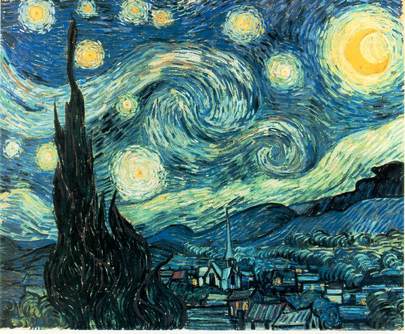
Locke, in Book 2, takes it upon himself to show where we get all our ides of knowledge. According to Locke, the mind is a blank slate, an empty piece of white paper, void of any ideas whatsoever. He says that, since the mind enters this world as an empty slate, all our ides regarding the world emanate from experience. This all knowledge is a result of our experiences. All that occurs to us comes to us directly through experience. If it is not as direct, it results from a past experience, or is in some way the result of some experience. For example, Locke might say that our concept of asthetics or beauty is not imprinted in the mind of a child as soon as the child comes out of the mothers womb, but rather it is in itself the very product of our experiences. We experience things that society considers to be beautiful and thus attribute beauty to anything possessing such characteristics and call that object beautiful.
Lets take the example further, just to prove the point. Take the example of painting. One of the most notable paintings today is Vincent Van Gogh's "A Starry Night." Now, people might say that the painting is beautiful. To Locke, this does not mean that the concept of beauty existsrt within all mankind, or for that matter the same concept of beauty exists in all human beings. He would say something like that this is a product of our experience. We experience that our society has certain concepts of beauty with regards to art and we impose these ideas on all paintings and by them judge the paintings to be beautiful or not. This is a product of society, and since societies can have differing notions of what it means to be a beautiful painting, some societies might consider this painting to be ugly.
Although I agree with Locke that there are ideas that are constructions of our experiences, I do not believe that this is always the case. There are certain ideas that exist throughout societies that I do not think can be doubted. Take for example the concept of the beautiful painting. It might be true that societies have differing concepts of beauty, and that says something about how society effects us, the fact that all societies have some concept of beauty would, to me, prove that there are at least some basic concepts that are common to all humans.
Independent Thinking in Locke's Ideology....

Although it is quite difficult to read, one of the first things one notices about Locke and his Essay is that he starts with an "Epistle to the Reader." In this he explains how the understanding arose for a need to systematically analyze human understanding in him. He also encourages ordinary readers to use their capacities of judgments instead of accepting what the intellectual society has already accepted. Locke explains that in everyday life, we all depend on some guidelines for our lives, and there are some forces that might be encouraging us t accept these guidelines blindly. According to Locke, this is wrong. Blind acceptance of borrowed principles leaves us in a situation whereby we accept some other absurd doctrines that are the effect of following such guidelines. The solution is to think independently.
What is interesting in this is that, if we accept this, we have to doubt everything that Locke said and come to our own conclusion about the matter. This is interesting not because it would go against what Locke wants, for it doesn't, but because Locke is being most unlike other "intellectuals". Others might want us to accept whatever they have said based on the fact that they are considered as "intellectuals", even though they are fallible human beings and that it is possible that they do not know all the implications of what they have said. Locke, although an odd case, is doing something that not only do I believe is right, but also something that is the main forte and reason for knowledge. I do not think that knowledge is not just the accumulation of information, but rather it is the processing of information that strengthens ones own thinking and analyzing capabilities and leads one to a conclusion based on the information gained. Based on this definition, what most "intellectuals do" is against the very principle of knowledge, and it is this same principle that Locke is trying to defend.
Possible Reasons for writing Part six of Discourse
Descartes declares in part six of his Discourse there are some pieces of his writing that he did not publish because he knew of a previous intellectual that published his works and got punished for not abiding what was the accepted doctrine. He declares that out of fear he will not do the same. I think that this was impressive on the part of Descartes that he could realize that society was not ready for some pieces of his work. There is a possibility that the person mentioned by Descartes was Galileo, a famous Enlightenment scientist known for his going against standard views of the church. It must be noted that Galileo was not someone denying Christianity- he did not say that he did not believe in God or Jesus or the Bible nor he did not say that the was a polytheists or an atheist. What he was opposed to was the idea upheld by the church that the Earth was the center of the world. He had observed that this was not true, and noted that Jupiter had moons that orbited it. He was declared a heretic by the church and was punished for this.
By noting this, possibly not wanting to go through the same fate, both for himself and his works. I think that this was a wise move on the part of Descartes, for he avoided the fate that befell Galileo and secured the success of his works.
By noting this, possibly not wanting to go through the same fate, both for himself and his works. I think that this was a wise move on the part of Descartes, for he avoided the fate that befell Galileo and secured the success of his works.
Descartes and the Demon

DESCARTES AND THE DEMON
Descartes declares in part one of his Meditations Descartes declares that we cannot believe in our senses. One of the reasons that he says we can not believe in our senses is that we do not know that we are being deceived or not. He says that there is a possibility that we are being deceived by a demon into to believing the world that we are seeing. This is an interesting statement that he has made, but I do not think that something so out of this world is necessary to call all our sense into doubt. All we need to realize is that our knowledge is limited.
Here someone might say "How do we know that our knowledge is limited?" The answer to this is that if we knew everything, there would not be any need for experiments and methods of analysis. But they are there. One could say it is the realization of our ignorance that has lead to the advancement of the many fields of knowledge, for if we did not realize our ignorance and believed that we already knew all, we would not even think of making the endevour towards advancement of knowledge.
Taking this into consideration, lets analyze one proposition that we hold dear: That our universe (including everything in it, like galaxies, stars, space, all matter, all antimatter, etc.) is the all there is. We like to think that. This is supported by the observations we make, which are just an extrapolation of our senses. Yet , if we take into consideration that we are do not possess knowledge of all, we can realize that our sense how our universe is all that can be mistaken. It is possible that it is wrong, and that in reality our galaxy is one single atom of one single object that that itself exists in a universe quite different from ours.
Thursday, April 24, 2008
kant scepticism
Kant says scepticism arose out of metaphysics and the lawlessness of it dialetic. At first skepticism declared in favor of the use of reason in experience, but as it was seen that the same principles a priori which are used in experience and as it seemed with equal right led further than experience reaches, doubt began to be placed even in principles of experience. There is no danger in this, for sound sense will always assert its rights in experience, but then there arose a confusion as to how far reason can be trusted. this confusion can only be removed, and all future relapses prevented, by formal determination, drawn from principles, of the boundaries of the use of reason. We can give no determinate concept of what things may be in themselves beyond all possible experience, but we are not free to refrain completely from enquiry after them; for experience is never entirely without reason. i think he means that you dont have to always doubt everything, like Descartes, but once reason works you can use it because it has proved to work.
kant appearance
Kant says that in appearance, every effect is an event, or something that happens in time; it must be preceded by a determination of the causality of its cause on which the effect follows according to a constant law. But this determination of the cause to causality must also be something that occurs. Or else the effect would have always existed, and also the cause. the determination of the cause to the act must have arisen among appearances and must also be an event, which also has a cause. but if freedom is to be a property of certain causes of appearances, it must be a faculty of beginning them of itself. But then the cause would not have to stand under time-determination of its state. it would have to be taken as a thing itself, but the effects would have to be taken only as appearances. If one can think such an influence of beings of the understanding of appearances without contradiction, the natural necessity will inhere in all connection of cause and effect in the world of the senses, but freedom will have to be conceded to that cause which is not itself appearance; nature and freedom will be capable of being attributed without contradiction to the same thing; but in a different regard; to it as appearance and to it as the thing itself.
Kant soul
kant defines the soul as the thinking self. he says it can be called a substance, as the ultimate subject of thinking which cannot itself be further represented as predicate of another thing, so it must have permanence. Permanence can only be proved for the purposes of experience, never out of the concept of a substance as a thing in itself. If therefore, we want to infer permanence of the soul from the concept of the soul from the concept of the soul as substance, this can only be valid of the soul for the purposes of possible experience, and not valid of it as a thing in itself and beyond all possible experience. The subjective condition of all possible experience is life, therefore only the permanence of the soul in life can be inferred, for the death of a human is the end of all experience. thus the permanence of the soul can only be shown in the life of a human, but not after death. And this on the concept of substance, insofar as it is to be regarded as necessarliy joined with the concept of permanence, can only be so joined according to a principle of possible experience and therefore only for the purposes of experience. The connection of the appearances of the objects outside a person according to laws of experience, proves the objective truth equally as the connection of the appearance of the inner sense proves the actuality of a person's soul. Kants says he knows his soul only as an object of inner sense, through appearances which constitute an inner state, and the essence of it in itself, which lies at the ground of these appearances, is unknown.
Kant Substantial self
Kant states that it has long since been known that the substantial self; that which is left over after all accidents(as predicates) have been taken away, is unknown. Pure reason leads us to an infinite regress of predicates, and nothing we reach can be taken as a final subject, and the substantial can never be thought by our understanding. Hence all real properties through which we know bodies are nothing but accidents, which one must always represent to oneself only as the effect of a force of which we do not have the subject. What we can see as substantial is the consciousness of ourself; for all predicates of the inner sense refer to the I as the subject, and the latter cannot be thought further as the predicate of any other subject. The absolute self is given in experience. But since the I is only a designation of the object of the inner self as we know it through no further predicate, and since it cannot itself be a predicate it cannot be a determinate of the absolute subject, but only the reference of the inner appearance to the unknown subject of them. Kant says this idea destorys all materialist explanations of the soul. And cognition of the the thinking being falls outside the sum total of experience.
Kant on Humean doubt
kant agrees with Hume that we can in no way have insight by reason into the possibility of causality. he adds that we have equally little insight into the concept of subsistence. We can have no insioght into how a consequence can be drawn from the state of one thing to the state of others things outside it. and how substances, which have their own existence, can be dependent on one another necessarliy. Kant believes these concepts and their principles stand a priori before all experience, and have thier undoubted objective rightness, though only in respect of experience. He says that he cannot conceive of the possibility of such a connection of existence, but he is more concerned with how cognition of things by experience is determined in respect of said moments of judgements in general; how things as objects of experience, can be and are to be subsumed under these concepts of the understanding. And it is clear that he has perfect insight into the necessity of subsuming all appearances under these concepts; into using them as principles of the possiblity of experience. he says that if a proposition that is a subjective connection of perceptions is to be a proposition of experience it must be regarded as necessary and universally valid. It would become a law, and valid because of the purpose of experience, which needs comprehensively and therefore necessarliy valid rules. So he says he does have insight into the concept of cause, as a concept necessarliy belonging to the mere form of experience, and into its possiblilty as a synthetic unification of perceptions in a consciousness in general; but he has no insight at all into the possibility of a thing in gerneral as a cause, because the concept of cause indicates a condition not attached in any way to the things, but only to experience, namely, that experience can only be objectively valid cognition of appearances and of their sequence in time if the antecedent appearance can be joined with the subsequent appearance according to the rule of hypothetical judgments.
kant's analytic/synthetic distinction
kant says all judgements can be separated into either a analytic or synthetic judgment. An analytic is a proposition whose predicate concept is contained in its subject concept. A mathematical equation like 10 + 11 + 21 is analytically true. A synthetic proposition is where the predicate concept is not contained in its subject concept. An example of this is like stating: Gas is expensive.
Tuesday, April 22, 2008
Hume on Mathemataics and Morality

David Hume claims that there is some difference between subjects like mathematics and morality, that mathematics discusses things that are concrete and their concepts are concrete. But morality is not like this. it is more relative. One could, as I will now, pose the question as to weather there is a difference in the essence of mathematics and like subjects and morality and other such subjects like it.
Why should there be such a question? The answer is simple. To answer this question lets ask the following:
1. What are the aforementioned subjects trying to analyze? If one wants to answer this, one could say that one is trying to analyze the physical world while the other is trying to analyze some ethical principles that society and the individual should use in their existence. It looks like there is a difference here, but this difference is only a surface level difference. If one looks at both the answer, one can conclude that both these subjects are analyzing one thing: the external world. Mathematics and morality are trying to both look at the world and make sense of it.
2. What is mathematics and what is morality? Do they exist in and of them self? It is preposterous to say that any subject should exist by itself in the world without there being an intellect to analyze it. The content of that subject matter, the "stuff" it studies might exist, but the subject itself is a product of the pondering of intellectual beings and thus could not exist with out them. There is no difference in this with regards to what subject it is. One could pose as an objection the statement that mathematics studies something concrete while morality studies that which is metaphysical. But this statement is flawed. Why? Lets see. Mathematics does not study physical objects, it studies numbers, or the representation of those objects. It does not matter that i say that two fish plus five fish equals seven fish or that i say that two balls plus five balls equals seven balls, the relation between these two examples, that of the addition of their quantities, is essentially the same. To take this point further, current mathematics does not just analyze numbers, but rather the philosophy of mathematics analyzes groupings of objects known as sets, a collection of objects symbolized as two brackets with their members in them. Yet again analysis does not focus on the physical objects but rather on something that makes them a part of a set. Thus mathematics does not study the physical, but rather it studies the metaphysical numerical relations between such objects.
Morality itself studies the metaphysical relations between objects and a society.
3. Doesn't morality essentially help man while mathematics is more or less ambivalent towards him? The answer here again is no. While the attempt to analyze morality itself can surely help man, if it used in a specific manner which meets that end, there is nothing in studying the subject of morality that specifically implies that studying it will help man. It can, if used in a certain manner. Mathematics is like this as well. Studying the subject of Mathematics does not imply that knowledge obtained by it will help man, but nor does it not imply that it wont help man if used in a specific context. Morality can help man if used a certain way. Mathematics can do the same if used in a certain manner. Which manner? Through scientific analysis that aims to help man. Mathematics is the language of science, and if science is used in a manner that helps man, then mathematics is really helping him as well.
SO, IS THERE A DIFFERENCE BETWEEN THE SUBJECTS JUST MENTIONED? YES, BUT ONLY IN SPECIFICS, NOT IN GENERALITIES OR IN ESSENCE. THE SUBJECT OF MATHEMATICS TRY TO ANALYZE SOME PARTS OF WHAT WE PERCEIVE WHILE MORALITY DOES THE SAME WITH OTHER PARTS.
Billard Balls, God , the Universe, and Miracles
One thing that I did find extremely interesting is how he tries to make the statement that putting God in the world and using God as the explanation for all universal phenomenon would some how degrade either the event itself or its analysis. the reason he uses is that every time a deity is used as the cause or the reason for an event happening is that when such a statement is made, it usually implies that the natural phenomenon and the rules governing them are somehow suspended so that God can take part as the cause of the event. This analysis is something that is degrading for analysis itself. Humanity uses God as the excuse and reason for everything, and using God as an answer for all leads to a halting of analysis and thinking.
I don't necessarily agree with this statement. When Hume makes this conclusion he is implying that the reason that he uses for such a conclusion is itself the only possibility. Herein lies his problem. He assumes that whenever there is an event and God is used as an answer to the question "What was the cause of this event?" that the laws of nature are suspended so that God can come in to the picture and thus He/She/It can intervene and become the cause. This would also mean that all other human inquiries regarding the cause for an event come to a halt (Who caused event x? Answer:God). Who is to say that God does not work through the laws governing the universe. With the aforementioned statement, natural laws aren't stopped and human beings can look into the natural cause for such natural events.
Some might pose the question "What of miracles?" This person might ask aren't they the work of God, and aren't they the cessation of natural events. The answer to this is that first one must establish that miracles are the cessation of natural events and that they themselves aren't the extension of the natural will o God, if such a deity exists, in the form of something that we would call a miracle.
I don't necessarily agree with this statement. When Hume makes this conclusion he is implying that the reason that he uses for such a conclusion is itself the only possibility. Herein lies his problem. He assumes that whenever there is an event and God is used as an answer to the question "What was the cause of this event?" that the laws of nature are suspended so that God can come in to the picture and thus He/She/It can intervene and become the cause. This would also mean that all other human inquiries regarding the cause for an event come to a halt (Who caused event x? Answer:God). Who is to say that God does not work through the laws governing the universe. With the aforementioned statement, natural laws aren't stopped and human beings can look into the natural cause for such natural events.
Some might pose the question "What of miracles?" This person might ask aren't they the work of God, and aren't they the cessation of natural events. The answer to this is that first one must establish that miracles are the cessation of natural events and that they themselves aren't the extension of the natural will o God, if such a deity exists, in the form of something that we would call a miracle.
Tuesday, April 15, 2008
Understanding
One of the thins that Hume declares is that neither philosophy nor morality should be treated negatively. Although the moralists might be wrong in seeking one single cause for human morals out of which all conduct should stem, it is not the case that the subject of morality should be treated as something not necessary and discarded. Rather we must delve more into the topic and understand its depth. But the sad thing is that the deeper we go into any subject, the more we are confronted with questions regarding human understanding. The more we are confronted with such questions, the more we begin to realize that analyzing and answering such questions is difficult because there is no single standard that determines what understanding is, how it works, and whether or not we are really understanding anything at all.
Hume on the human being
David Hume begins his Enquiry by saying that the human being has different interests. Man has an interest in philosophy, business, and other things as well. It should not be such that there is only one interest in mankind that takes the lead. But rather they should exist together in man. Man, who is composed of numerous interests, should not limit himself to just one of these. Even the philosopher who secludes himself from the rest of society is dependent on some form of other desires to live.
Monday, April 7, 2008
Hume soul
Hume asserts, that the soul, as far as we can conceive it, is nothing but a system, or train of different perceptions, those of heat and cold, love and anger, thoughts and sensations; all united together, but without any perfect simplicity or identity. Descartes maintained that thought is the essence of the mind. Hume says this is unintelligible since everything is particular, and therefore it must be our several perceptions that compose the mind. The mind is not a substance in which perceptions inhere. We have no idea of substance of any kind, since we have no impression of any substance eithe material or spiritual. We know nothing but particular qualities and perceptions. As our idea of any body, a peach, for instance, is only that of a particular taste, color, figure, size. So our idea of any mind is only that of particular perceptions, without the notion of anything we call substance, either simple or compound.
I think Hume is describing the parts of the mind and body as the whole thing. I think Descartes argues that the sum of the parts creates the whole mind, and the essence of the mind is thought because it takes the perceptions from the parts and creates other ideas which are real. But Hume, using the parts instead of the whole, sees the perceptions as real instead of the ideas or the reason the senses perceived what they did.
I think Hume is describing the parts of the mind and body as the whole thing. I think Descartes argues that the sum of the parts creates the whole mind, and the essence of the mind is thought because it takes the perceptions from the parts and creates other ideas which are real. But Hume, using the parts instead of the whole, sees the perceptions as real instead of the ideas or the reason the senses perceived what they did.
Hume Sceptical Part III
Hume says there is a useful scepticism. The greater part of mankind are naturally apt to be affirmative and dogmatical in their opinions; and while they see objects only on one side, and have no idea of any counterpoising arguments, they throw themselves into the principles, nor have they any indulgence for those who entertain opposite sentiments. Another attribute to Pyrrhonian, excessive scepticism, doubt, is the limitation of our enquiries to such subjects as are best adapted to the narrow capacity of human understanding. When dealing with the sciences a proposition can be determined false, an argument can be proven using cause and effect experiences. But if we reason a priori, anything may appear able to produce anything. Such is the case in moral understanding. So Hume suggests a middle path of scepticism.
Hume Sceptical Part II
Hume says there is can be nothinng more sceptical, or more full of doubt and hesitation, than scepticism itself. Moral scepticism and the reasonings behind it are popular, and objections derive from the natural weakness of human understanding. Hume says the sceptics would not survive by themselves in the world. I think he suggests not being so sceptical at present and moving on in an attempt that the sceptical questions will be answered by an intellect not yet achieved.
Hume Sceptical Philosophy
In this section Hume talks about the inefficiency of the Cartesian doubt. He says there is a species of sceptism, antecedent to all study and philosophy, which is much inculcated by Descartes and others, as a sovereign preservative against error and precipitate judgment. It recommends an universal doubt, of all things. He says that since these philosophers are looking for an unshakable principle by doubting all the faculties of reason, then they could not step beyond this principle because it would require them to use these faculties that are full of doubt. Therefore, the Cartesian doubt, if it were possible to be attained by humans, which it is not, would be entirely incurable; and no reason could bring us to a state of assurance on any subject. He admits the senses are not to be fully trusted, but the perceptions of the senses are not to be entirelt disregarded, like how the skeptics disregard them. They are to be corrected by reason. Hume says that our contemplation of objects do not have any effect on the objects existence. The images in our mind are not the real objects, and have no effect on the quality of those objects. Hume says it begins to be necessary to use reason to contradict the senses, but human reasoning is incapable of being infallible and cannot assume infallibility in nature.
Hume Reason of Animals
Hume begins this section by stating that all our reasonings concerning matters of fact are founded on a species of Analogy, which leads us to expect from any cause the same events, which we have observed to result from similar causes. Where the causes are entirely similar, the analogy is perfect, and the inference, drawn from it, is regarded as certain and conclusive. He states that animals as well as humans learn many things from experience, and infer, that the same events will always follow from the same causes. He says that animals can be trained using rewards and punishment to go against their natural instincts. Animals infer some facts beyong their senses and this inference is founded on by past experiences. But he also says that an animal will answer to their name when called upon by a human using a different voice than they have heard, and know they are being called and not another animal. Hume suggests that Nature must have given some other principle of more general application to these animals. And not only the animals, but children and men also are endowed with this principle. If what we infer is from cause and effect, then why can we understand certain senses when the senses are not exactly the same? Hume says animals and humans are also endowed with certain instincts that let them know how to raise thier young or stay away from fire, so not only is cause and effect the only way to understand. Hume does not say this is the action of the soul, he is vague in describing and naming the principle that he says Nature has provided for the animals. But can't this just be the soul that Descartes was talking about, and it is just a question of semantics?
Friday, April 4, 2008
Hume Of the Association of Ideas
Hume explains, in this section, his idea of the connection of ideas. He says there is a regular method to the different ideas of our minds, and the appearance to the memory or imagination. He says even the wildest ideas have some connection to other ideas. He says there appears to be three principles of connexion among ideas: Resemblance, Contiguity, and Cause and Effect. For Resemblance he uses the example of a picture leading our thoughts to the original scene. For Contiguity he uses the example of the mentioning of an apartment in a building leads us to enquire about the other apartments. And for Cause and Effect he uses the example of a wound which leads us to reflecting on the pain which follows it. He says the only way to prove these principle is by volume. The more instances we examine, the more assurance we acquire. All the examinations bind the different thoughts together perpetually, until we accept the principle as general as possible. Like how Locke proves existence by cause and effect of something, and how nothing comes from nothing, this may be also how Hume proves anyting to exist.
Hume Origin of Ideas
Hume begins his Section II by stating there is a significant difference between the perceptions of the mind, and when a memory is recalled, or a sensation is anticpated. He says these faculties may mimic or copy the perceptions of the senses; but they never can entirely reach the force and vivacity of the original sentitment. The most lively thought is still inferior to the dullest sensation. Our ideas do not require any metaphysical head to distinguish these perceptions. I think here Hume is beginning to argue against the soul even existing. He distinguishes our perceptions into two parts: ideas and impressions. Ideas are the abstract thoughts of our minds, and impressions are the effects of our senses. He goes on to say that humans do not create any original ideas. Obscure images are made up of putting images we have witnessed together. And abstract ideas come from degrees of other abstract ideas. He argues that there could be one contradictory situation to this philosophy, where a person who has seen every shade of blue except one is shown all the shades of blue and can realize that there is a shade missing within the gradation of the colors. I do not see how this is different than his argument for degrees of abstract ideas, where God is an idea of the greatest goodness or highest intelligence. This blue that is missing can be easily understood by anyone who has never seen it it they notice the difference in the other blues. It is like discovering an idea serendipitously, then using not only the knew knowledge, but also the new way to obtain knowledge. He ends this section by saying all abstract ideas are faint and obscure, and all impressions are strong and vivid. He says it does not take any meta-head to make these distinctions, but if the body is capable of feeling these impressions so vividly at any given time, why can't it feel it the same way at any other time?
Friday, March 14, 2008
Locke Soul
Locke says the soul begins to have ideas when it begins to perceive. It's essence is not to think, and it does not always think, like the body does not always move. I do not think Locke thinks the soul has any innate ideas either. He says there is something within humans that has the power to think, but he believes it is not always functioning in this way. It seems to me that Locke believes the soul acts like the mind, it thinks, it reason, and has the ability to think and reason in degrees. He does believe it exists separately from the mind and body also. I think the mind operates as it does in accordance to how it is supposed to physically, and the ideas are reasoned by the soul, which understands the universe in a way that the mind and body cannot. I think Lock thinks the soul thinks like the body thinks. When a new sensation is shown to the body it reacts as it should, and the mind tries to understand the sensation as it should. So, too, the soul reacts to the mind and body as it should, in accordance to the universe.
Locke Origin of Ideas
Locke says all ideas come from sensation or reflection. Sensation is the affect of external objects. It is from our perceptions of the external world that we feel sensations. Reflection is the operation of the mind after the ideas have entered our minds. These include: perception, thinking, doubting, believing, reasoning, knowing, willing, and all different actings of the mind. It is from these two areas that all our ideas originate. From these operations of sensation and reflection sometimes passions arise which leave us feeling certain ways about the ideas. Why do we feel differently about different ideas? What makes us believe a certain idea is right or not? Can that be the action of the soul?
Locke Innate ideas
Locke argues that many me believe that ideas that are universally agreed upon by all mankind are innate and are stamped upon the mind of man, which the soul receives in its very first being, and brings into the world with it. Locke argues this is not the case to prove ideas are innate because there are ways to come to these ideas that all men consent in. He says no ideas that are universally agreed upon. Children and idiots would have these ideas imprinted on them, like all humans, but they do not understand the ideas, and there is no reason to imprint the ideas on minds that would not understand them. Besides the known ideas of hunger, pain, cold, etc., Locke says there are no innate ideas. No innate ideas of principles or morals.
Locke Identity
Locke explains that what is, is, and what is not, cannot be. When we see anything to be in any place in any instant of time, we are sure that it is that very thing, and not another, which at that same time exists in another place. And this is identity, because it is inconceivable that two things of the same kind should exist in the same at the same time; therefore all things that exists anwhere at anytime is there itself alone. He goes on to talk about the identity of substances, and there are three sorts of substances: God, Finite intelligences, and Bodies. First, God is without beginning, eternal, unalterable, and everywhere; and therefore His identity is undoubtable. Finite spirits have their own determinate time and place, and the relation to that time and place will always determine to each spirit its identity. Lastly, the same will hold true of every particle of matter, to which no addition or subtraction of matter be made. Locke says when concerning a living object there is something else that determines its identity. For an oak is the same oak when it is cut, and a man is the same man as he changes.
Thursday, March 6, 2008
locke xxvi human views of existence
locke here explains the reason to believe anythig exists is because everything has a cause and an effect. so any idea that enters our mind is study by us and therefore the idea exists. he goes on the explain that everthing that exists has a relation to something else. humans know "old" in relation to something of similar attirbutes being "young". they know "big" in relation to something that is "small" that is known to be the same thing in question, like a small dog compared to a big dog. and humans understand space and time because in relation to events happening in other space and at other times. when dealing with absolute terms, that which is being described can be compared to anything. it is sensation and reflection that compares all ideas. he says that time and space are described by other time and space, but does not talk about the first time or the creation of space. i think he is just trying to prove what exists because for there to be an effect there must be a cause, and that cause must exist.
Locke XIX mind/body and will
Locke begins this chapter by defining the modes of thinking. he says thinking occurs when the mind turns its view inwards. "Sensation" is any impression on the body made by an external object, which is the entrance of any idea into the understanding of the senses. "rememberance" is the reoccurance of the sensation without the external object. ideas that float in the mind without any understanding are "reverie". Ideas that are taken notice of are "attention". ideas that the mind takes great interest in are "study". These are some instances that Locke says the mind may observe itself. then he goes on to explain attention. there are ideas that are always present in the mind, and some ideas that are so earnest that the mind shuts out all other thoughts, and takes no notice of the ordinary impressions made then on the senses, at other times the mind barely observes the train of ideas that succeed in the understanding without directing and pursuing any of them, and at other times it lets them pass almost unregarded.
he concludes by saying thinking is the action of the soul and not the essence. if thinking has so many modes and the mode of attention has different degrees, then it is probable that the soul is acting and thinking is not its essence. because the essence of any agent is not capable of variation. i think he is explaining that even though the mind is constantly working and thinking there still exists a will that choose how the mind studies certain ideas. and so this will cannot be a prisoner of its own function if its function is to reason.
he concludes by saying thinking is the action of the soul and not the essence. if thinking has so many modes and the mode of attention has different degrees, then it is probable that the soul is acting and thinking is not its essence. because the essence of any agent is not capable of variation. i think he is explaining that even though the mind is constantly working and thinking there still exists a will that choose how the mind studies certain ideas. and so this will cannot be a prisoner of its own function if its function is to reason.
Descartes function of the soul
descartes believes in free will as regards to right and wrong. he believes the soul and body are separate and body functions as it does because of it's parts, but humans can reason and this ability is separate from the body. Ibn Sina, the islamic philosopher, believed the function of man is to praise God. Locke says thinking is the action of the soul and not the essence. i think all of them believed humans can choose their actions, but not the consequences. will exists within the universe, which is infinite.
descartes discourse 5 in regards to machines
Descartes says that machines can be made by humans in all the likeness of humans, but a soul cannot be created for them. Only God can create a soul. So therefore, machines cannot function as a human, only mimic one. A machine can be programmed to adhere to a vast amount of functions, but still finite. where a machine fails a certain task that a human has asked of it, the human can choose an alternative approach. Humans cannot do everything, but this is not their function as intended by God. God created a human to be able to choose to change themselves. Like machines can understand their function as bestowed on them from their creator, but never understand the reason for the intention, so too can humans understand their function, but never the understand the reason of God's intent. Therefore, humans do have a will and a function, and both include choice.
Tuesday, February 5, 2008
Second Meditation
D's second meditation talks of his doubts, or rather the fact that he does doubt, percieve, is aware of sensory data surrounding, that he must exist, unless he believes he is being decieved by a supreme diety. He starts thinking toward the idea that maybe his thought is separate from his body. All the while during this meditation i believe he is questioning the "I" what it is, this undescribable entity for he even states "...the actual words bring me up short." In short of a breakthrough he is confused of his own thoughts and whether there is any bearing to them.
MEDITATIONS
First Meditation
The main question h at Descartes tries to answer in the First Meditation of Meditations is, as is put in the book “What can be called into doubt.” He starts out by declaring that he has does not believe in a lot of that which he used to. To be exact, the phrase is “[s]ome years ago I was struck by the large number of falsehoods that I had accept as true in my childhood and by the highly doubtful nature of the whole edifice that I had subsequently based on them.” He basically starts to question exactly what he can be certain about and from that point he develops his statement into three ee different types, or levels, of doubts. Concerning level one, he explicitly states that “whatever I had admitted until now as most true I received either from the senses or through the senses”-meaning that it was his senses that were deceiving him into accepting that which he was not real. Yet even the senses aren’t totally deceptive-only a madman would deny his sensual perception that “the hands and this entire body are mine.” In level two he proposes the argument that it is possible that we are just dreaming and that because our reality is a dream it cannot be reality. What we perceive, our entire universe and our existence within it, are just figments of someone or something’s imagination conjured up while dreaming. To this he answers that if we are in a dream, we can believe that the things that exist in our reality exist, to some extent, in the real world as well. In the final level of doubt he discusses the idea that God or some other being (demon) could be deceiving us.
Safi's Part of Discourse

DISCOURSE ON METHOD
Part Six
Part Six
Descartes declares that although he does not like to publish his views, he feels that, after seeing the success of his previous works that by getting more published his writing would be a great benefit to the general human population if his works were made public and written in vernacular. He hopes that in doing this work others will feel encouraged to do similar work as well. He hopes that many specialists would aid him. Although he is cautious and says that these people will not be driven by the love of the intellectual pursuit but rather the desire for money. He however decides not to publish his work, and cites the reason being how someone else’s work on the same subject he wants to write about was treated. He wants his work to be published after his death so that he doesn’t have to be interrupted from doing his work. He declares that all his success has been due to overcoming six obstacles in his path, and he, if left uninterrupted, would be able to tackle all the other problems if left free form controversy.Objections were raised that if published, people would try to find errors in Descartes works and that they might be successful in doing so. He answers this by saying that he has never confronted any plausible objection that he had not already anticipated. He also feels that other people can help develop this discussion more.What is really necessary in understanding Descartes’ work, he says, is not to say what one is not. Don’t profess to be knowledgeable when you are ignorant. Admit that you are ignorant and try to gain knowledge. But at the end, according to Descartes, those people who want to gain knowledge, will create their own investigations.It is for these aforementioned reasons, namely staying away from the public eye, that Descartes decided not to publish his work on physics three years ago. He changed his mind for two reasons.They are:1. To dispel any rumors that his findings are false2. Because he feels the need to seek help from other scientist. He hopes that people will critically read his works, especially those on Optics meteorology, and geometry
Monday, February 4, 2008
Discourse 5
Discourse 5 talks about functioning. God created material things and set them in course, and it is easier for us to understand these things as they develop rather than witnessing them in completed form. God has created animals and man as to function as he wishes. It is reason that proves the independence of humas. Animals can speak, but not reason, and a machine can only be programmed to do so much. A machine cannot be made to utilize the total necessary organs to reason, and animals cannot reason at all. Therefore, animal souls are completely different from human souls. And the sould cannot be derived from the potentiallity of matter; it must be specially created. It must be independent of the body to constitute a real man or else it would be inhibited by the body.
Finally, because their is a God, then their is reason to fear and hope after the present life, and when a person accepts the soul's independence of the body there is no reason to believe the soul dies with it and no reason to believe the soul dies at all.
Finally, because their is a God, then their is reason to fear and hope after the present life, and when a person accepts the soul's independence of the body there is no reason to believe the soul dies with it and no reason to believe the soul dies at all.
Discourse 4
Descartes begins Discourse 4 by stating that he is rejecting all things that he finds any doubt in. He questions if anything exists. By thinking he realizes that he must be something. He declares his supposition, "I think therefore I am", as an unshakable basis. And from this basis he argues that his whole essence is to think.
He states that ideas do not exist within him, but come from a superior begin; God. And it is as certain as any geometric proof that God exists. Therefore, the ideas that enter him must be true, and we are not wholly perfect so that we can understand that everthing true comes from a perfect being.
Finally, reason does not insist that what we see is true, but becasue God is perfect and truthful all our ideas must have a foundation of truth.
He states that ideas do not exist within him, but come from a superior begin; God. And it is as certain as any geometric proof that God exists. Therefore, the ideas that enter him must be true, and we are not wholly perfect so that we can understand that everthing true comes from a perfect being.
Finally, reason does not insist that what we see is true, but becasue God is perfect and truthful all our ideas must have a foundation of truth.
Subscribe to:
Posts (Atom)