Tuesday, February 5, 2008
Second Meditation
D's second meditation talks of his doubts, or rather the fact that he does doubt, percieve, is aware of sensory data surrounding, that he must exist, unless he believes he is being decieved by a supreme diety. He starts thinking toward the idea that maybe his thought is separate from his body. All the while during this meditation i believe he is questioning the "I" what it is, this undescribable entity for he even states "...the actual words bring me up short." In short of a breakthrough he is confused of his own thoughts and whether there is any bearing to them.

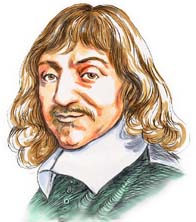
MEDITATIONS
First Meditation
The main question h at Descartes tries to answer in the First Meditation of Meditations is, as is put in the book “What can be called into doubt.” He starts out by declaring that he has does not believe in a lot of that which he used to. To be exact, the phrase is “[s]ome years ago I was struck by the large number of falsehoods that I had accept as true in my childhood and by the highly doubtful nature of the whole edifice that I had subsequently based on them.” He basically starts to question exactly what he can be certain about and from that point he develops his statement into three ee different types, or levels, of doubts. Concerning level one, he explicitly states that “whatever I had admitted until now as most true I received either from the senses or through the senses”-meaning that it was his senses that were deceiving him into accepting that which he was not real. Yet even the senses aren’t totally deceptive-only a madman would deny his sensual perception that “the hands and this entire body are mine.” In level two he proposes the argument that it is possible that we are just dreaming and that because our reality is a dream it cannot be reality. What we perceive, our entire universe and our existence within it, are just figments of someone or something’s imagination conjured up while dreaming. To this he answers that if we are in a dream, we can believe that the things that exist in our reality exist, to some extent, in the real world as well. In the final level of doubt he discusses the idea that God or some other being (demon) could be deceiving us.
Safi's Part of Discourse

DISCOURSE ON METHOD
Part Six
Part Six
Descartes declares that although he does not like to publish his views, he feels that, after seeing the success of his previous works that by getting more published his writing would be a great benefit to the general human population if his works were made public and written in vernacular. He hopes that in doing this work others will feel encouraged to do similar work as well. He hopes that many specialists would aid him. Although he is cautious and says that these people will not be driven by the love of the intellectual pursuit but rather the desire for money. He however decides not to publish his work, and cites the reason being how someone else’s work on the same subject he wants to write about was treated. He wants his work to be published after his death so that he doesn’t have to be interrupted from doing his work. He declares that all his success has been due to overcoming six obstacles in his path, and he, if left uninterrupted, would be able to tackle all the other problems if left free form controversy.Objections were raised that if published, people would try to find errors in Descartes works and that they might be successful in doing so. He answers this by saying that he has never confronted any plausible objection that he had not already anticipated. He also feels that other people can help develop this discussion more.What is really necessary in understanding Descartes’ work, he says, is not to say what one is not. Don’t profess to be knowledgeable when you are ignorant. Admit that you are ignorant and try to gain knowledge. But at the end, according to Descartes, those people who want to gain knowledge, will create their own investigations.It is for these aforementioned reasons, namely staying away from the public eye, that Descartes decided not to publish his work on physics three years ago. He changed his mind for two reasons.They are:1. To dispel any rumors that his findings are false2. Because he feels the need to seek help from other scientist. He hopes that people will critically read his works, especially those on Optics meteorology, and geometry
Monday, February 4, 2008
Discourse 5
Discourse 5 talks about functioning. God created material things and set them in course, and it is easier for us to understand these things as they develop rather than witnessing them in completed form. God has created animals and man as to function as he wishes. It is reason that proves the independence of humas. Animals can speak, but not reason, and a machine can only be programmed to do so much. A machine cannot be made to utilize the total necessary organs to reason, and animals cannot reason at all. Therefore, animal souls are completely different from human souls. And the sould cannot be derived from the potentiallity of matter; it must be specially created. It must be independent of the body to constitute a real man or else it would be inhibited by the body.
Finally, because their is a God, then their is reason to fear and hope after the present life, and when a person accepts the soul's independence of the body there is no reason to believe the soul dies with it and no reason to believe the soul dies at all.
Finally, because their is a God, then their is reason to fear and hope after the present life, and when a person accepts the soul's independence of the body there is no reason to believe the soul dies with it and no reason to believe the soul dies at all.
Discourse 4
Descartes begins Discourse 4 by stating that he is rejecting all things that he finds any doubt in. He questions if anything exists. By thinking he realizes that he must be something. He declares his supposition, "I think therefore I am", as an unshakable basis. And from this basis he argues that his whole essence is to think.
He states that ideas do not exist within him, but come from a superior begin; God. And it is as certain as any geometric proof that God exists. Therefore, the ideas that enter him must be true, and we are not wholly perfect so that we can understand that everthing true comes from a perfect being.
Finally, reason does not insist that what we see is true, but becasue God is perfect and truthful all our ideas must have a foundation of truth.
He states that ideas do not exist within him, but come from a superior begin; God. And it is as certain as any geometric proof that God exists. Therefore, the ideas that enter him must be true, and we are not wholly perfect so that we can understand that everthing true comes from a perfect being.
Finally, reason does not insist that what we see is true, but becasue God is perfect and truthful all our ideas must have a foundation of truth.
Subscribe to:
Posts (Atom)